
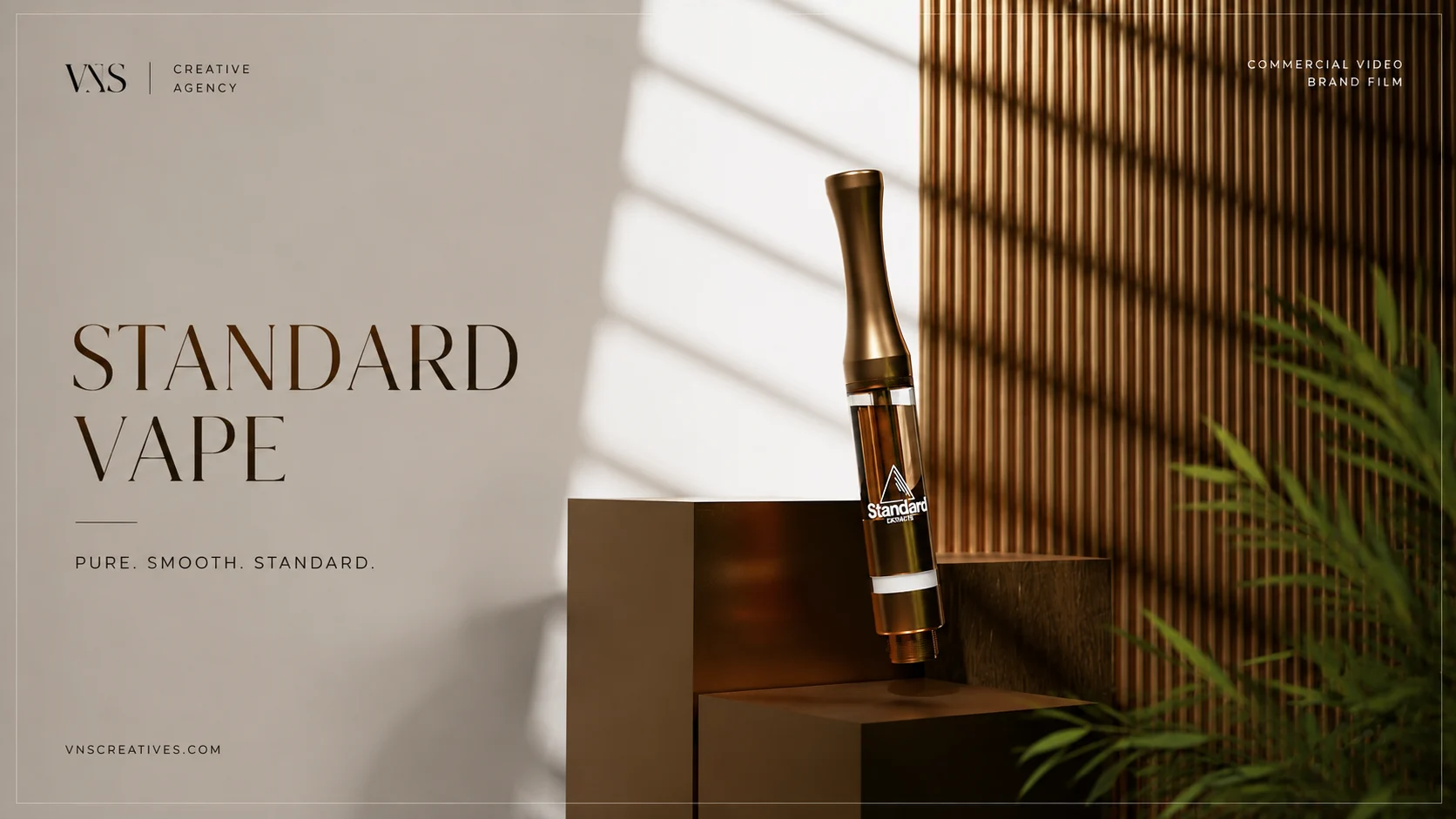
The challenge with a product commercial is simple: how do you make the product memorable?
For the Standard Vape commercial, our approach was to build the visual story around the product itself rather than surrounding it with unnecessary elements.
The device becomes the focal point of the frame while the camera, lighting, background, materials, and transitions work together to create a polished commercial presentation.
The purpose of the project wasn’t to demonstrate how complicated CGI can be.
It was to use CGI to make a relatively compact product feel substantial on screen.
Every shot was therefore considered from the perspective of product presentation.
Where should the viewer look?
What part of the device should be revealed?
How should the light travel across its surface?
When should the camera move?
And how should one shot lead naturally into the next?
These questions shaped the creative direction of the commercial.
What Makes a Small Product Difficult to Film in an Interesting Way?
A compact product can actually be more challenging to advertise than a large object.
There are fewer obvious visual elements for the camera to explore.
The silhouette needs to be clear.
The surface needs to react well to light.
Close-ups need to reveal meaningful details.
And camera movements need to feel intentional.
This is where 3D animation product workflows become useful.
The entire digital environment can be designed around the physical dimensions of the Standard Vape.
Instead of trying to make an ordinary studio setup look interesting, we can create compositions specifically for the product.
That gives the creative team control over scale, perspective, distance, and camera movement.
How Did We Decide What the Audience Should See First?
A commercial doesn’t need to reveal every part of a product immediately.
Sometimes withholding information creates more visual interest.
For Standard Vape, the sequence can be structured around controlled reveals.
A partial view can establish curiosity.
A camera movement can gradually expose the silhouette.
A closer shot can reveal packaging or surface details.
A wider composition can then establish the complete product.
This approach turns product animation into a visual progression.
Instead of presenting the entire product in one frame, the animation gives the audience several reasons to continue watching.
How Did We Build the Digital Version of Standard Vape?
Before the product could be animated, it needed to exist as a detailed 3D asset.
This stage involves translating the physical product into digital geometry.
The model needs to preserve the important visual characteristics of the device, including its proportions, corners, curves, surface transitions, and design details.
This becomes particularly important when working with close camera shots.
A small modeling error might not be visible in a wide composition, but it can become obvious when the camera moves directly across the surface.
The digital model therefore needs to be prepared not just for rendering, but for the demands of the complete commercial.
What Role Did Surface Materials Play in the Final Look?
A convincing product CGI shot depends on more than geometry.
The viewer also needs to understand what the product is made from.
Materials determine how light behaves across the surface.
They influence the intensity of highlights, the softness of reflections, and the way edges appear against the background.
For Standard Vape, the materials were developed with the commercial lighting in mind.
Instead of treating the product as a single flat surface, different material properties can be controlled to create a more convincing physical appearance.
This becomes especially noticeable during camera movement, when highlights and reflections travel across the product.
How Did We Use Light to Reveal Rather Than Hide the Product?
Dramatic lighting can look impressive, but product advertising requires a certain amount of discipline.
If the light is too intense, important details disappear.
If the scene is too flat, the product loses depth.
The lighting for the Standard Vape commercial was therefore treated as a way of sculpting the product visually.
A highlight can describe an edge.
A shadow can separate two surfaces.
A reflection can reveal curvature.
A subtle gradient can separate the product from the background.
This makes lighting an active part of the storytelling rather than something added at the end.
How Did We Make the Camera Feel Like a Real Commercial Camera?
One of the risks of CGI is making camera movement feel mechanical.
A technically perfect movement can still feel unnatural if it has no cinematic intention.
For Standard Vape, camera choreography was approached around the way a real commercial might introduce a premium product.
Instead of moving randomly around the object, the camera can:
- Approach the product gradually
- Shift perspective to reveal its form
- Move past specific details
- Create controlled rotations
- Settle into a hero composition
This is an important part of 3D product animation because the camera itself becomes part of the product storytelling.
Why Did We Avoid Making the Animation Overly Complicated?
A commercial can become weaker when every shot tries to be spectacular.
If the viewer is constantly watching effects, transitions, particles, and camera tricks, the product can become secondary.
The Standard Vape commercial was therefore approached with a product-first mindset.
The visual effects exist to support the product.
The lighting creates atmosphere.
The camera creates movement.
The environment creates depth.
But the device remains the main subject.
This type of restraint is especially useful for brands that want their products to feel premium rather than excessively stylized.
How Did the Background Become Part of the Product Presentation?
The background isn’t simply empty space behind a product.
It affects contrast, reflections, mood, and perceived color.
In a CGI environment, the background can be designed specifically around the product.
That allows the creative team to control how the product separates from the scene.
A darker environment can emphasize bright surfaces.
A lighter environment can create a cleaner presentation.
A gradient can add depth without introducing additional objects.
This is one of the reasons CGI product animation provides so much flexibility for commercial work.
The environment can be changed without physically rebuilding a studio set.
How Did We Keep Different Shots Visually Consistent?
A commercial may contain several camera angles, but the product should still feel like the same physical object.
Consistency needs to be maintained across:
- Product scale
- Materials
- Lighting
- Reflections
- Background treatment
- Camera perspective
- Color balance
This is one area where a controlled 3D video production pipeline becomes valuable.
Because the product exists inside the same digital scene, its geometry and material properties can remain consistent while the camera changes.
The result is a sequence that feels connected rather than like a collection of unrelated product shots.
What Makes CGI Particularly Useful for a Product Commercial?
Imagine wanting to change the camera angle after the commercial has already been designed.
With a physical shoot, that could mean repositioning the product, rebuilding the camera setup, changing lights, and potentially reshooting.
With CGI, the digital scene can be adjusted.
The camera can be moved.
The product can be repositioned.
The lighting can be modified.
The environment can be changed.
This flexibility is one of the strongest reasons brands choose 3D video production for highly controlled product advertising.
It allows creative decisions to remain flexible deeper into the production process.
How Did We Use Animation Without Making the Product Feel Artificial?
Animation doesn’t necessarily mean that the product has to perform exaggerated movements.
For a product commercial, subtle movement can often be more effective.
A controlled rotation can reveal the silhouette.
A small movement can catch a highlight.
A camera push can create anticipation.
A slow transition can shift attention toward another detail.
This is where animation product storytelling differs from simply making an object move.
The movement needs to have a reason.
If the product moves, the audience should discover something because of that movement.
How Did We Approach Rendering for the Standard Vape Commercial?
Rendering is where the modeled product, materials, lighting, camera, and animation finally become visible as finished frames.
High-quality product rendering requires attention to several factors.
Reflections need to be calculated accurately.
Shadows need sufficient detail.
Materials need to respond correctly to the scene.
Depth of field needs to be controlled.
And the overall image needs to retain enough detail for commercial use.
Because these calculations can become demanding, optimization is also part of the process.
The objective is to achieve a high-quality image without adding unnecessary computational complexity.
What Did We Learn From Creating This Standard Vape Commercial?
The project reinforced an important principle:
A strong product commercial doesn’t need to show everything at once.
Sometimes the strongest approach is to control what the viewer sees and when they see it.
A well-designed camera path can create curiosity.
Good lighting can reveal the physical character of the product.
Accurate materials can make CGI feel believable.
And a carefully designed environment can give a small product a much stronger presence.
These principles can be applied to many different industries, from consumer electronics to beauty and personal-care products.
Our Oud Beauty 3D Animation project, for example, uses a different visual direction while applying the same product-first CGI philosophy.
How Does Standard Vape Relate to Our Other Product Animation Projects?
Every product presents a different creative problem.
A beauty product may require a softer, more elegant visual language.
An oral-care product may need a cleaner and more informative presentation.
A device can require stronger emphasis on form, materials, and industrial design.
Our ORL Organic Oral Care 3D Animation project shows how a completely different category can be translated into a digital product experience.
The technology behind the production may overlap, but the creative decisions are shaped by the individual product.
That distinction is important.
Good CGI isn’t about applying the same template to every product.
It is about creating the right visual treatment for each one.
How Can the Standard Vape Digital Asset Be Reused for Future Content?
One advantage of creating a product digitally is that the asset can potentially continue working after the original commercial is complete.
The Standard Vape model can be used to generate additional product views, still renders, alternative camera angles, or new animated sequences.
For example, a brand could use the same asset to create additional visuals for a website or digital campaign.
Our 3D product rendering work explores how digital product assets can be used to create high-quality product imagery alongside animation.
This makes the initial CGI production potentially more valuable than a single video.
Why Can 3D Product Animation Work Well for Social Media Campaigns?
Social media gives brands very little time to capture attention.
A static product image can communicate information, but movement can immediately create another layer of engagement.
3D product animation gives brands the ability to create short product-focused clips specifically for digital platforms.
A few seconds of controlled camera movement can show more than a single static angle.
A close-up can reveal a design detail.
A rotation can show the overall form.
A dramatic transition can create a memorable opening.
The same commercial asset can potentially be edited into multiple shorter pieces of content.
How Can 3D Product Animatie Help Brands Create Consistent Visual Content?
The term 3D product animatie is another way of describing digitally animated product visualization.
For brands producing content regularly, this approach can help maintain consistency.
The same product geometry can be reused.
Materials can remain consistent.
Brand colors can be maintained.
Lighting setups can be adapted.
New camera movements can be created without rebuilding the product.
This provides a foundation for producing different pieces of visual content while keeping the product representation consistent.
What Makes Standard Vape a Good Example of Product CGI?
The Standard Vape project demonstrates how a relatively compact consumer product can be transformed into a complete commercial visual experience.
The product itself provides the foundation.
CGI provides control over its presentation.
The camera provides movement.
Lighting provides definition.
Materials provide realism.
The environment provides atmosphere.
And animation connects everything together.
The final result is not simply a digital representation of the device.
It is a carefully constructed visual presentation designed around how the product should be perceived.
How Can VNS Creatives Approach Your Next Commercial Video?
At VNS Creatives, we work with products that need more than a basic photograph or static render.
Our 3D animation product workflow can cover digital modeling, materials, lighting, camera animation, rendering, compositing, and final commercial production.
Our CGI product animation resource explores how this type of production can transform a physical product into a cinematic digital experience.
For beauty and personal-care brands, our cosmetic photography work also demonstrates how product-focused visual content can be approached through photography.
For brands looking for a broader creative production partner, our creative agency in Mumbai resource provides additional insight into our approach to commercial creative work.
The Standard Vape commercial is ultimately an example of what happens when product design and digital cinematography are treated as one visual problem.
Instead of simply asking how to show the product, we ask:
How should the audience experience it?
That question shapes the modeling, materials, lighting, camera movement, animation, and final edit—and that is where product animation becomes more than a technical service.
It becomes a tool for creating a memorable product identity.
Explore More VNS Creative Agency Projects
Interested in more CGI and 3D work? Explore the VNS Creative Agency portfolio or browse the latest articles through the VNS Creative Agency blog.
For brands looking for photorealistic 3D product visualization, CGI product rendering, product photography, or commercial product animation, get in touch with us at manager@vnscreatives.com.
Project: AZIO Retro Classic Keyboard
Category: 3D Product Visualization / CGI / Photorealistic Rendering
Project Type: Personal 3D Project
Created By: VNS Creative Agency
Explore more: VNS Creative Agency Blogs | Portfolio | Contact Us