
What Was the Creative Idea Behind the Michael Taylor Product Animation?
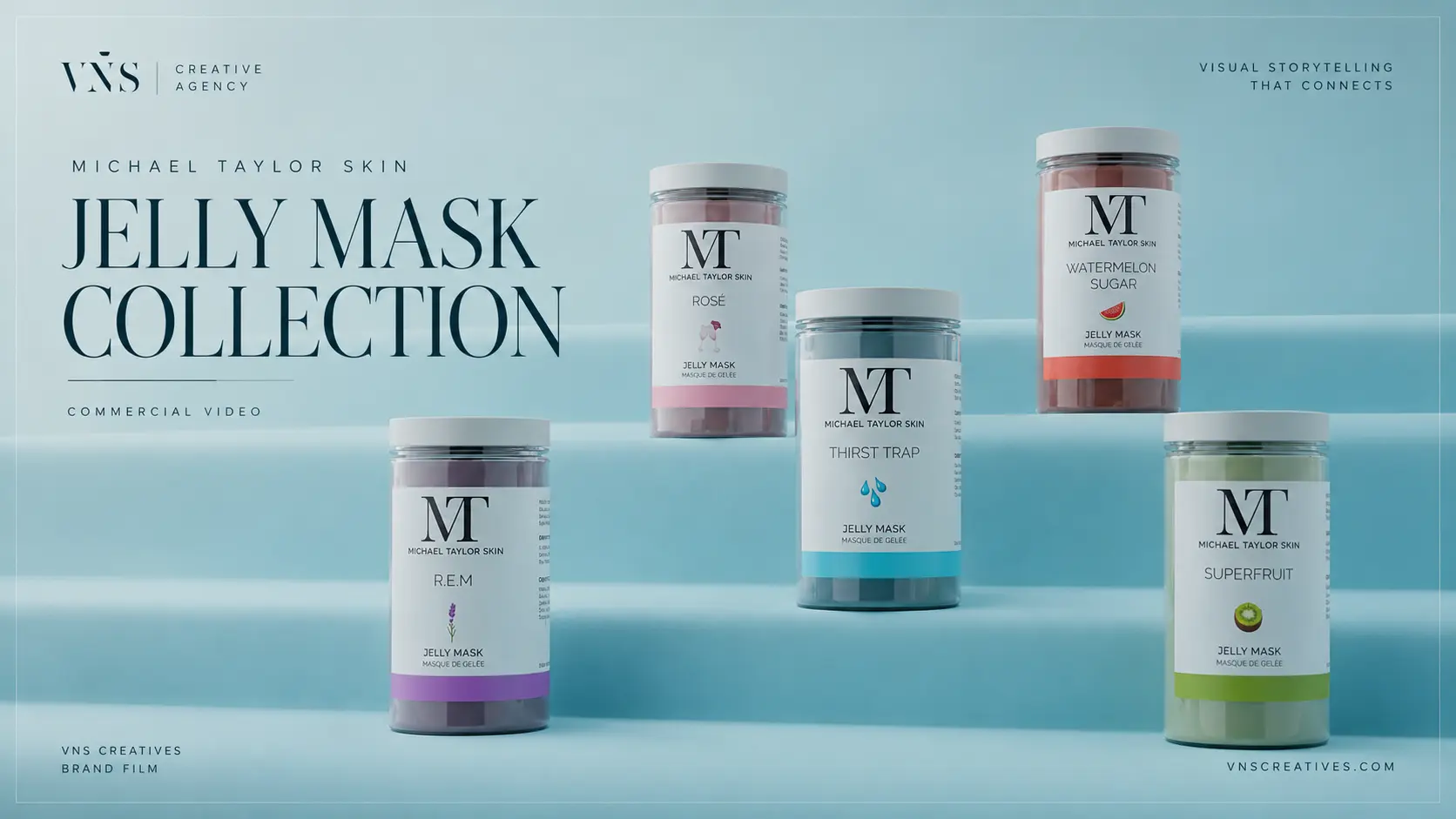
The Michael Taylor skincare commercial was created around a simple but visually powerful idea: make the product, its colors, its environment, and the music work together as one experience.
Instead of placing the skincare product against one fixed studio background, we created a digitally controlled environment where the background color changes according to the color of the product.
This decision became one of the defining visual elements of the commercial.
As the product changes, the environment changes with it. The color of the background complements the packaging and creates a different visual mood for each moment of the video.
The animation was also designed around the beat of the music. Product movements, camera movements, transitions, and color changes were timed to the soundtrack so that the visual sequence feels synchronized rather than simply placed over music.
The result is a skincare commercial where product color, CGI, animation, music, and camera movement all contribute to the storytelling.
Why Was 3D Animation Product the Right Choice for Michael Taylor?
For the Michael Taylor project, 3D animation product production gave us the creative freedom needed to build the entire commercial around the product.
A traditional shoot would require physical sets, lighting setups, camera equipment, and multiple product arrangements. With 3D, the product and its environment could be constructed digitally and controlled throughout production.
The camera could move precisely around the product. The lighting could be adjusted for every shot. The background could change color without physically rebuilding a set. The product could be rotated and animated according to the music.
This is particularly useful when the creative concept depends on elements changing together.
Our approach to animation product production is focused on creating movement that supports the product and its story, rather than simply making a product rotate on screen.
For Michael Taylor, that meant using CGI as a creative tool rather than treating it as just a technical method of rendering the product.
How Did 3D Product Animation Make the Michael Taylor Product the Hero?
The main purpose of the 3D product animation was to make the skincare product the focal point of every scene.
The animation was designed so that the background, lighting, camera, and transitions support the product rather than compete with it.
The product remains visually dominant while the environment provides contrast and movement.
Camera movements reveal different parts of the packaging, while controlled lighting creates highlights and reflections across the product surface.
The product also moves in response to the rhythm of the commercial, giving the animation energy without making the movement feel unnecessary.
This approach is important in commercial product animation because visual effects should enhance product communication rather than distract from it.
The viewer should finish the video remembering the Michael Taylor product, not simply remembering that they saw a CGI sequence.
Why Did the Background Change According to the Michael Taylor Product Color?
One of the most distinctive elements of the Michael Taylor commercial is the relationship between the product color and background color.
Rather than using a single environment throughout the film, the background changes according to the product being presented.
This creates a visual connection between the packaging and its surroundings.
The product effectively influences its environment.
If the product introduces one color, the surrounding environment responds with a complementary visual treatment. When the commercial moves to another product or visual moment, the environment changes again.
This creates variety without making the commercial feel disconnected.
The background therefore becomes more than a simple backdrop.
It becomes part of the product presentation.
This type of visual control is one of the strongest advantages of product CGI, because the entire environment can be designed specifically around the product rather than being limited by a physical studio setup.
How Did Color Become Part of the Product CGI Storytelling?
Color plays an important role in skincare and beauty branding because packaging color can influence how a product is recognized and perceived.
For Michael Taylor, we used this characteristic as part of the visual storytelling.
Instead of allowing the packaging color to exist independently, we extended it into the surrounding environment.
The result creates a visual flow:
Product → Color → Background → Lighting → Movement → Transition
Each element supports the next.
The changing colors also help separate different sections of the commercial. Rather than relying entirely on cuts, the change in environment provides a visual signal that the commercial is moving into a new moment.
This makes the product CGI feel more dynamic while keeping the overall visual language consistent.
The approach is particularly effective for beauty and skincare products because the visual environment can reinforce the product’s identity without adding unnecessary objects or props.
How Did CGI Product Animation Follow the Beat of the Music?
The soundtrack was an important part of the CGI product animation process.
The animation was not treated as something that would be completed first and then simply placed over a piece of music.
Instead, the beat helped determine the timing of the visual movements.
Product rotations, camera movements, transitions, and changes in the environment were structured around important moments in the soundtrack.
A movement can feel much more powerful when it lands exactly on a beat.
A product reveal can become more dramatic when it coincides with a musical transition.
A background color change can become visually stronger when it happens at the same moment as a change in the soundtrack.
This creates synchronization between what the audience hears and what they see.
The music provides the rhythm, while the CGI product animation translates that rhythm into visual movement.
Why Does Beat-Synced Product Animation Feel More Dynamic?
Simply moving a product does not automatically make an engaging commercial.
Timing is what gives movement meaning.
For the Michael Taylor commercial, animation was structured around different levels of energy.
Some moments allow the product to remain stable so the viewer can appreciate the packaging.
Other moments introduce faster camera movement, product rotation, color transitions, or changes in composition.
This contrast prevents the animation from feeling repetitive.
The beat acts as an invisible framework connecting these movements together.
When a visual transition happens at precisely the right musical moment, the audience naturally perceives the commercial as more energetic and intentional.
This is an important part of professional 3D product animation — understanding that animation isn’t only about movement, but also about timing, rhythm, anticipation, and visual emphasis.
How Did 3D Video Production Give Us Control Over Every Shot?
The Michael Taylor commercial required a complete 3D video production workflow rather than a simple animated product render.
The product, environment, camera, lighting, materials, animation, and transitions all had to work together.
The digital workflow allowed each element to be controlled independently.
If a camera movement needed to be slower, it could be adjusted.
If the background color needed to transition at a particular beat, it could be timed precisely.
If the lighting needed to create a stronger highlight on the packaging, the lighting setup could be modified.
This flexibility is particularly valuable when creating commercials where visual elements need to change rapidly.
The production becomes less about physical limitations and more about achieving the intended creative result.
How Was the Michael Taylor Product Created for CGI?
Before animation could begin, the physical skincare product had to be recreated as a detailed digital asset.
The 3D model forms the foundation of the commercial.
Its proportions, geometry, edges, packaging details, labels, and surface characteristics need to be accurately represented.
This becomes especially important when the camera moves close to the product.
A small modeling issue that might not be noticeable in a distant shot can become obvious during a close-up.
Once the product has been recreated accurately, however, it can be used from practically any camera angle and placed into different environments without physically reshooting the product.
This is one of the reasons 3D product animation is particularly powerful for commercial product visualization.
How Did We Create Realistic Materials for the Michael Taylor Product?
A digital model is only one part of convincing product CGI.
The next step is making the materials behave realistically.
Skincare packaging may include different finishes such as glossy plastic, matte surfaces, metallic elements, printed labels, transparent components, or reflective details.
Each material responds differently to light.
Glossy surfaces produce sharper highlights.
Matte surfaces create softer reflections.
Metallic surfaces respond strongly to their surrounding environment.
These characteristics need to be recreated digitally so that the product maintains a believable physical appearance.
For Michael Taylor, the materials and lighting were developed to create a polished commercial appearance while preserving the actual visual character of the skincare packaging.
The objective was not to make the product look artificially shiny.
The objective was to make the CGI product feel like a real premium object being filmed in a carefully controlled environment.
How Did Lighting Work With the Changing Background Colors?
The changing backgrounds created an additional challenge for the lighting.
When the environment changes color, the product still needs to maintain consistent shape, detail, and visual clarity.
The lighting therefore had to work with the different color environments while continuing to create realistic highlights and shadows.
This required careful attention to how light interacts with the product surface.
The background contributes ambient color.
The lights define the product’s form.
Reflections communicate the material.
Shadows create depth.
Highlights draw attention to important packaging details.
When these elements are balanced correctly, the product remains visually consistent even as the surrounding environment changes.
This is one of the details that separates professional CGI product animation from a basic 3D render.
How Did Camera Movement Make the Animation Product Feel Cinematic?
Camera movement was designed specifically around the product.
Instead of using movement simply because the project was an animation, each camera action was intended to reveal something.
A wider shot can establish the color environment.
A slow push-in can create emphasis.
A rotation can reveal another side of the packaging.
A close-up can highlight a particular detail.
A transition can move the viewer naturally into the next product moment.
Because the camera exists digitally, the movement can be controlled with a high degree of precision.
This gives the animation product a cinematic quality while maintaining a clear commercial purpose.
The camera isn’t the hero.
The camera’s job is to make the product look like the hero.
How Were the Transitions Created Between the Different Product Colors?
The transitions were designed to connect the different visual moments of the commercial.
Because the background changes according to the product color, the color itself becomes part of the transition system.
A scene can gradually shift into another color environment while the product moves or the camera changes position.
The transition can then land on the next beat of the soundtrack.
This combination creates continuity between scenes.
Instead of feeling like separate clips edited together, the commercial becomes one continuous sequence where the environment, product, camera, and music evolve together.
That continuity is particularly important in short commercial films because there is very little time to establish a visual idea before moving to the next one.
How Does the Michael Taylor Commercial Compare With Other VNS Product Animation Projects?
The Michael Taylor commercial follows the same product-first philosophy that we apply across different CGI projects, while using a completely different creative treatment.
For example, our Oud Beauty 3D animation project explores premium beauty-product presentation through CGI, lighting, materials, and controlled camera movement.
Our ORL Organic Oral Care 3D animation work takes a similar product-focused approach within the personal-care category.
The important point is that CGI does not have to look the same for every brand.
The technology can remain consistent while the creative direction changes according to the product.
For Michael Taylor, the creative identity came from color-changing environments and beat-driven animation.
Why Can CGI Product Animation Be More Flexible Than a Physical Shoot?
A physical product shoot has physical limitations.
Changing the background may require a new set.
Changing the lighting may require rebuilding the setup.
Changing the camera angle can require repositioning equipment.
Creating several different environments can increase production complexity.
With CGI product animation, these elements exist digitally.
The same product can be placed into multiple environments.
The camera can move freely.
Lighting can be redesigned.
Colors can change.
Products can be repositioned.
And the entire sequence can be revised without physically handling the product for every adjustment.
For the Michael Taylor commercial, this flexibility was particularly valuable because the concept depended on the environment changing alongside the product.
How Can 3D Product Animatie Help Skincare Brands Create Better Visuals?
The phrase 3D product animatie is sometimes used to describe the same production approach as 3D product animation: using digitally created products and environments to create engaging visual content.
For skincare brands, this can be particularly useful because the category depends heavily on visual presentation.
A brand can use 3D to create product commercials, social media content, product-launch videos, digital advertisements, ecommerce imagery, website visuals, and campaign assets.
The important advantage is creative control.
Instead of simply showing the product, a brand can build an environment around it.
The product can influence the color of the scene.
The camera can move around it.
Lighting can reveal its materials.
Animation can follow the soundtrack.
And transitions can be designed specifically around the product.
What Makes Product Animation Effective for Beauty Products?
Good product animation isn’t about adding as many effects as possible.
It is about knowing what the animation needs to communicate.
For Michael Taylor, the creative system was built around a few key relationships:
The product provides the focus.
The product color influences the environment.
The background establishes the visual mood.
The camera creates perspective.
The lighting creates realism.
The animation creates movement.
The music creates rhythm.
The transitions connect the sequence.
This creates a commercial where every visual decision has a relationship with the product.
That is ultimately what makes the animation useful for advertising.
How Can One 3D Product Become Multiple Marketing Assets?
A major advantage of creating a detailed digital product is that the asset can potentially be used beyond one commercial.
Once the product has been accurately modeled, textured, and prepared for rendering, it can become the foundation for additional content.
The same digital asset can be used for product renders, social media animations, website visuals, ecommerce content, advertising campaigns, product launches, and future videos.
This is where 3D product rendering can become part of a broader content strategy.
Instead of creating every product visual from scratch, brands can build a reusable digital version of the product and develop different visuals from that foundation.
This can also help maintain consistency across different marketing channels.
Why Is 3D Video Production Becoming More Important for Skincare Brands?
Skincare brands now compete for attention across websites, social media, ecommerce platforms, digital advertising, and short-form video.
A product therefore needs to look compelling wherever it appears.
This is where 3D video production can provide a major creative advantage.
The brand is not restricted to one physical studio environment.
The product can exist inside a completely designed visual world.
Colors can change.
Camera movements can be precisely controlled.
Lighting can be cinematic.
Product animation can follow music.
And the entire commercial can be created around the brand’s visual identity.
For beauty and skincare products, this creates an opportunity to make the product presentation itself part of the marketing experience.
How Did VNS Creative Approach the Michael Taylor Commercial?
The Michael Taylor project was approached as a creative product film, not simply as a technical CGI exercise.
The starting point was the product.
From there, the visual direction was developed around its colors, packaging, movement, and the rhythm of the soundtrack.
The background changes according to the product color.
The animation responds to the beat.
The camera movement creates visual depth.
The lighting makes the product feel realistic.
The transitions connect the different visual moments.
Together, these elements create a commercial that is designed around the product from beginning to end.
The result demonstrates how 3D animation product workflows can be used not just to display products, but to create a complete visual identity around them.
What Does the Michael Taylor Commercial Show About the Future of Product CGI?
The Michael Taylor project demonstrates that product CGI can go far beyond recreating a physical product digitally.
It can create an entirely controlled visual world around that product.
A product’s color can influence its environment.
Music can determine animation timing.
Camera movement can create perspectives that would be difficult to capture physically.
Lighting can be adjusted specifically for every material and surface.
Transitions can be designed around individual beats.
The result is a commercial where the product doesn’t simply sit inside an environment.
The environment is designed around the product.
How Can VNS Creative Create a 3D Product Commercial for Your Brand?
A product commercial should do more than show a product.
It should communicate what the product represents.
At VNS Creative, we combine 3D product animation, product CGI, CGI product animation, 3D video production, modeling, materials, lighting, camera animation, rendering, and post-production to create product-focused commercial content.
Our work can be explored through our CGI product animation resources, where we dive deeper into how CGI can be used to create high-quality product visuals.
For beauty and skincare brands, CGI provides the freedom to create environments that respond directly to the product.
The Michael Taylor commercial is a strong example of this approach: the product color influences the background, the animation follows the beat, the camera creates movement, and the CGI environment is built around the product.
If your brand is looking for a different approach to product advertising, explore VNS Creative’s work and discover how 3D product animation, product CGI, and 3D video production can turn your product into a cinematic commercial experience.
For brands interested in combining CGI with traditional visual production, our work around cosmetic photography also shows how different product-visualization techniques can support modern beauty marketing.
What Makes Michael Taylor a Strong Example of Modern Skincare Advertising?
The Michael Taylor commercial shows how a relatively focused creative concept can become a complete visual language when every production element supports the same idea.
The product determines the color.
The color influences the environment.
The environment affects the mood.
The music determines the rhythm.
The beat influences the animation.
The camera guides the viewer.
The lighting creates realism.
And the transitions connect everything together.
That combination is what makes the commercial more than a standard product video.
It turns the skincare product into the center of a designed visual experience.
For brands looking to make their products stand out in an increasingly competitive digital environment, 3D product animation and CGI product animation offer the creative control needed to create product films that are memorable, adaptable, and visually distinctive.
Partner with VNS Creative Agency
At VNS Creative Agency, we transform vehicles into visual experiences that drive engagement and build brand value. Whether you’re launching a new model or refreshing your brand, our cinematic 3D images provide the storytelling power you need.
Contact us today to elevate your automotive marketing with professional 3D imagery.
check our more images on portfolio
Contact Us to start your project
Explore More Work